About Impact Investing

Impact investing is the practice of deploying capital into companies, organisations, and funds with the specific, intentional goal of generating measurable, beneficial social or environmental impact alongside a financial return. It goes beyond philanthropy, aiming to address global challenges—such as climate change, healthcare, or education—through investments that can yield competitive market-rate or below-market returns.

To achieve a sustainable future for all mankind, the world needs companies that can drive positive change at scale through products and services. Impact investing can spur the growth of such companies and help advance solutions to address the social and environmental challenges the world faces today.

To underscore the importance of authenticity, investors and companies must have intentionality and accountability to measure the impact they generate, both positive and negative.

Sources: OECD


The impact landscape spans a spectrum of approaches and strategies pursued by a variety of players operating at different stages of their respective impact journeys.

While impact investing does not equate to a sacrifice in profit and often generates well above market rate returns, it is true that impact-oriented investments bring a range of expected returns, from market rates to concessionary returns. In some cases, such as venture philanthropy, investors may seek no financial return at all, but do evaluate the promise of commercial viability of their investments as an important criterion.
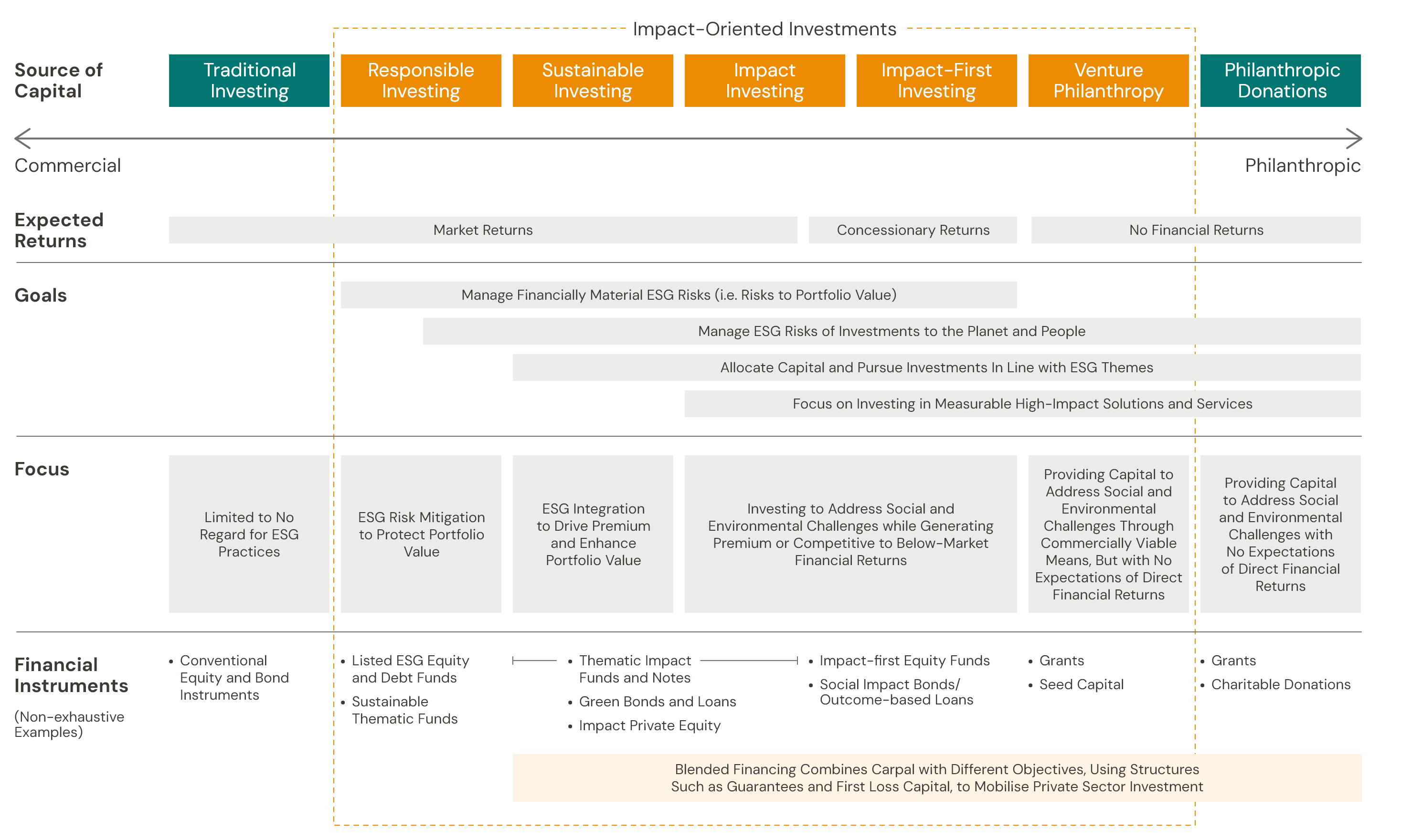
Source: Adapted by CIIP, SMU, and Accenture, based on the UNDP, Credit Suisse, Bridges Fund Management, The Impact Investing Institute, and PwC


Similar to the case of investors, impact-oriented companies adopt a range of approaches and strategies to impact. Indeed, impact orientation – albeit to different degrees – is increasingly adopted by established businesses, while a growing breed of entrepreneurs is building businesses with impact at its core, applying market forces to solve social and environmental problems.
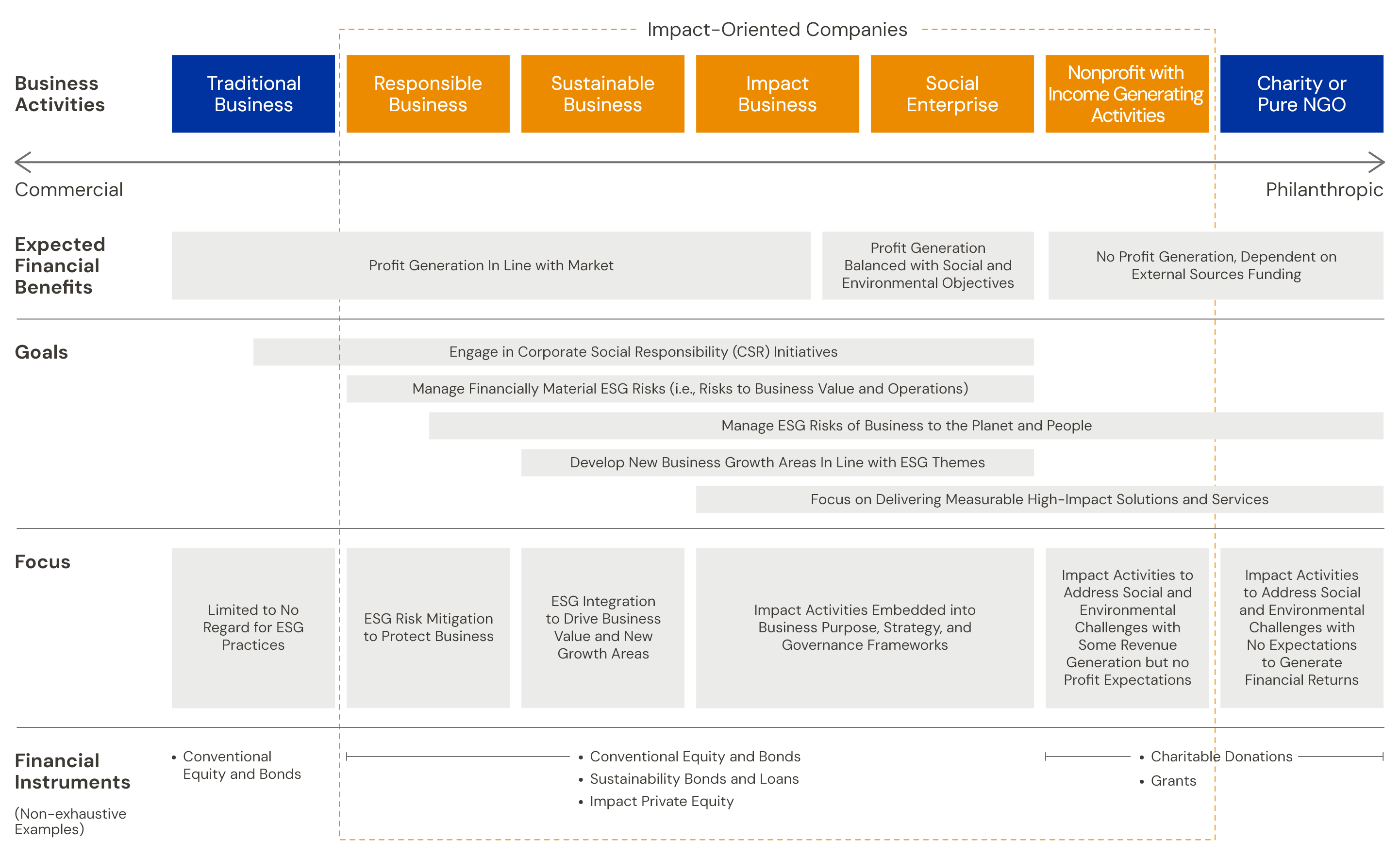

Source: Adapted by CIIP, SMU, and Accenture, based on the UNDP and Brown University


While impact investors strive for a double bottom line, many sustainable development challenges require the development of complex and unproven technologies that are less viable to deploy commercially or at scale. This is where different forms of capital such as philanthropic capital can contribute.

Philanthropies have distinct risk absorption capacities to invest in nascent and disruptive technologies. Shifting from traditional ‘chequebook philanthropy’ towards viewing philanthropy as risk or catalytic capital can further drive the development of upstream solutions that achieve impact outcomes, instead of only treating consequences downstream.

The blended financing approach supports collective action among different types of investors with its collaborative framework. It leverages philanthropic and development capital as risk capital to mobilise additional commercial capital to address pressing issues not yet ready for commercial investments. Blended financing remains under-utilised today. More can be done by all sectors, together, to mobilise the capital required to address the SDG funding gap.

These different types of investors can reference impact measurement and management toolkits as they come together to contribute risk capital that drives innovative solutions. Clear criteria, measurable goals, and consistent tracking will contribute towards more successful impact outcomes.


In recent years, the introduction of Environmental, Social, and Governance (ESG) factors in decision making and operations has steered companies towards creating long term, sustainable value for stakeholders and communities.
The adoption of ESG interests is however limited if emphasis is placed on financial materiality and decisions are motivated by reporting requirements, compliance needs, and risk mitigation.

Today, many investors and companies reference ESG factors to set the baseline and minimum threshold for responsible investments and to avoid doing harm through their business activities. This narrow approach is shifting as more frameworks and regulations begin to adopt double materiality – accounting for the impact of businesses on society and environment, in addition to financially material ESG factors.

Beyond merely acting to avoid harm as prescribed by ESG factors, leading investors and companies are starting to go further and striving to contribute to solutions that address our social and environmental challenges, in tandem with their pursuit of profits.

Today, ESG factors set the baseline and the minimum threshold for responsible businesses to avoid harm and are integrated into a growing majority of mainstream investment decision-making.

Impact investors go beyond ESG. They are intentional with their capital and seek to finance solutions to social or environmental challenges via the entrepreneurs and businesses that they back.

In 2015, the United Nations (UN) issued the Sustainable Development Goals (SDGs) as a universal call to action to “end poverty, protect the planet and improve the lives and prospects of everyone, everywhere” by the year 2030.

With the 17 SDGs being interconnected with action in one area affecting outcomes in another, different stakeholders from around the world must work together in order to solve the most pressing challenges that our world faces today.

The UN estimates an annual financing gap of approximately US$4.2 trillion to achieve the SDGs in developing countries. This gap represents a significant surge, exacerbated by pandemic-related debt, climate-related disasters, and geopolitical conflicts.

Bridging this gap will require all forms of capital and practitioners, whether public, private, or philanthropic, to come together and work towards generating positive impact for people and planet.

This is the time for collective action among governments, businesses, investors, research institutions, philanthropic organisations, NGOs, and the community.

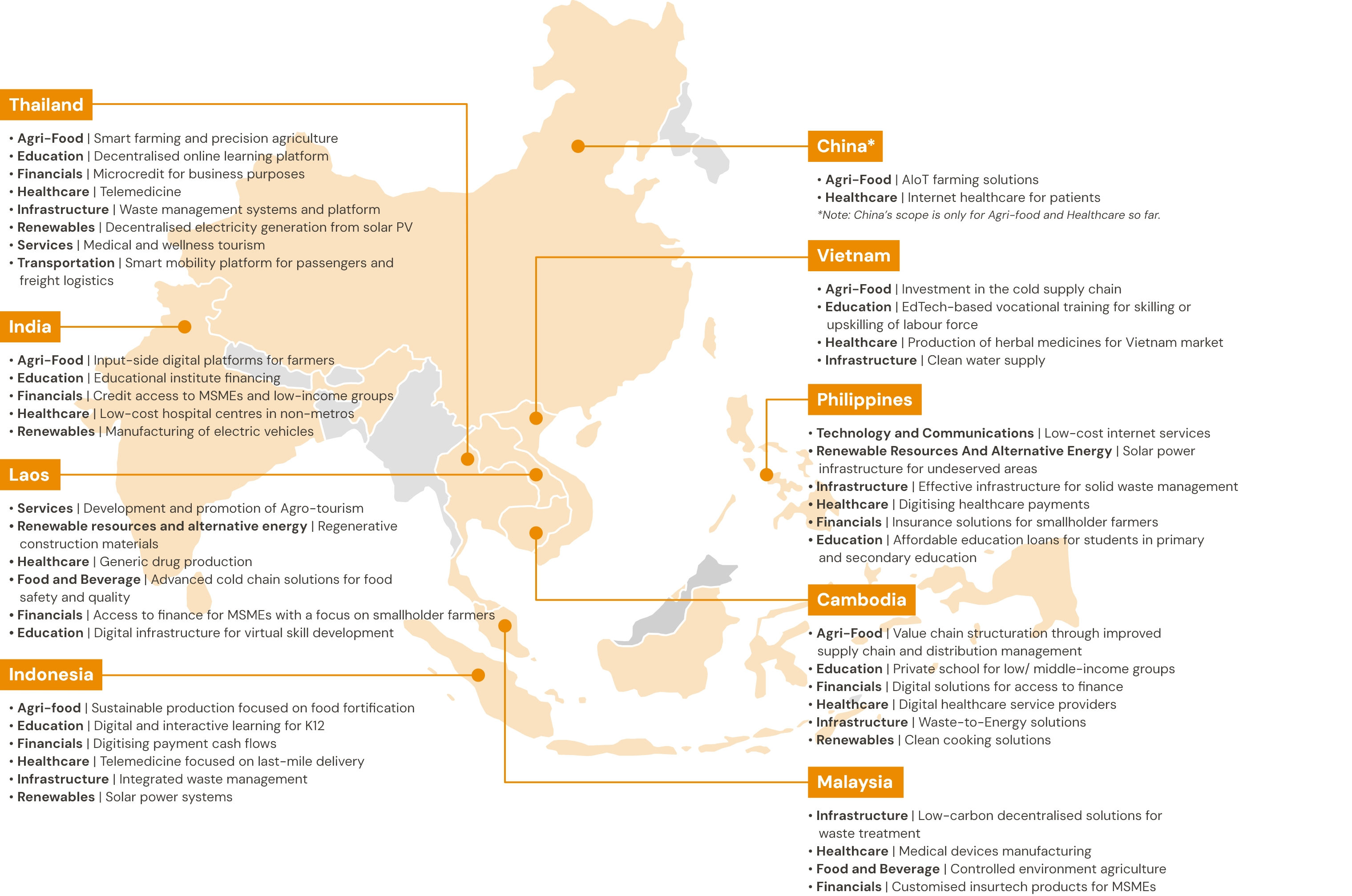
The SDG Investor Maps are market intelligence tools designed to direct private capital toward sustainable development projects in emerging markets.

The IOAs highlight Investible Opportunity Areas (IOAs) that contribute to addressing the SDGs while generating attractive financial returns, and align with both national development priorities and financial profitability.

Developed by the United Nations Development Programme (UNDP) Private Finance for the SDGs, the Maps provide investors and businesses with clarity, insights and tools that support their contributions towards achieving the SDGs.

CIIP is the Asia anchor partner for UNDP Private Finance for the SDGs, and supported the development of the SDG Investor Maps for Southeast Asia. The maps for Southeast Asia are available on the CIIP website, and all maps are available on the SDG Investor Platform hosted by UNDP Private Finance for the SDGs.

Source: UNDP SDG Impact | Note: The SDG Investor Platform provides detailed analyses on the IOAs in each market


There are many factors that underpin Asia’s potential for impact at scale. Here are some key factors that we believe anchor Asia’s impact potential:


A long-standing emphasis on collaboration with, engagement of, and consideration for multiple stakeholders, including the community

Large population with rising purchasing power and an emerging consumer class - Southeast Asia, South Asia, and East Asia is home to ~55% of the world’s total population, nearly a billion youths, and 20 economies in the low to upper middle-income range

Many industries that are still in the early stages of development, representing significant market potential that can be tapped

Technology- and digitally-enabled business models enabling reach to previously excluded segments of consumers and suppliers

A burgeoning entrepreneurial talent pool to spur innovation and solutions

This is adapted from our 2022 report “Scaling Impact in Asia: Achieving Purpose and Profit, by CIIP, Accenture and SMU”.

We look forward to
hearing from you!